[ . BACK to WORLDKIGO TOP . ]
:::::::::::::::::::::::::::::::::::::::::::::::::::::::::::::::::::::::::::::::::::::::::::::::::::
Tosa Diary (Tosa Nikki)
***** Location: Japan
***** Season: Non-seasonal Topic
***** Category: Humanity
*****************************
Explanation
Tosa Nikki 土佐日記 Tosa Diary
by
Ki no Tsurayuki 紀貫之
(872-945)
Nikki bungaku (日記文学) is a genre of Japanese diary literature including prominent works such as the Tosa Nikki, Kagerō Nikki, and Murasaki Shikibu Nikki. While diaries began as records imitating daily logs kept by Chinese government officials, private and literary diaries emerged and flourished during the Heian period (794-1192 AD).
Although scholars have found diaries dating back to the eighth century, most of those were mere records kept on daily matters of state. At that time, Japan looked to China as a model of culture and civilization and sought to copy Chinese official government diaries. Thus, early Japanese diaries were factual, written in Chinese characters, and influenced by official, male perspectives.
Ki no Tsurayuki (872?-945), a famed poet and author, is credited with writing the first literary diary.
His Tosa Nikki, written in 935, records his journey from Tosa in Shikoku to Kyoto through the alleged perspective of a female companion. Departing from the tradition of diaries written in Chinese, Tsurayuki used vernacular Japanese characters, waka poetry, and a female narrator to convey the emotional aspects of the journey.
© More in the WIKIPEDIA !
:::::::::::::::::::::::::::::::::::::::::::::::::::::::::::::::::::::::::::::::::::::::::::::::::::
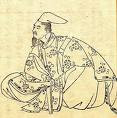
Ki no Tsurayuki
was a Japanese author, poet and courtier of the Heian period.
Tsurayuki was a son of Ki no Mochiyuki. He became a waka poet in the 890s. In 905, under the order of Emperor Daigo, he was one of four poets selected to compile the Kokin Wakashū, an anthology of poetry.
After holding a few offices in Kyoto, he was appointed the provincial governor of Tosa province and stayed there from 930 until 935. Later he was presumably appointed the provincial governor of Suo province, since it was recorded that he held a waka party (Utaai) at his home in Suo.
He is well-known for his waka and is counted as one of the Thirty-six Poetry Immortals selected by Fujiwara no Kinto. He was also known as one of the editors of the Kokin Wakashū. Tsurayuki wrote one of two prefaces to Kokin Wakashū; the other is in Chinese. His preface was the first critical essay on waka. He wrote of its history from its mythological origin to his contemporary waka, which he grouped into genres, referred to some major poets and gave a bit of harsh criticism to his predecessors like Ariwara no Narihira.
His waka is included in one of the important Japanese poetry anthologies, the Hyakunin Isshu, which was compiled in the 13th century by Fujiwara no Teika, long after Tsurayuki's death.
Besides the Kokin Wakashū and its preface, Tsurayuki's major literary work was the Tosa nikki (土佐日記) (Tosa Diary), which was written using kana.
The text details a trip in 935 returning to Kyoto from Tosa province, where Tsurayuki had been the provincial governor.
Most researchers have long believed that Tsurayuki impersonated a woman, because they assume that kana was usually by women in the Heian Period.
© More in the WIKIPEDIA !
Out in the marsh reeds
A bird cries out in sorrow,
As though it had recalled
Something better forgotten.
A lovely flower withered,
with its colors gone,
the fragrance
lingers faintly
at the temple bell.
preface to the Kokinshu 古今集 (ca. 905)
*****************************
Worldwide use
Die alte Provinz Tosa
Tosa ist der alte Name der heutigen Präfektur Koochi. Tosa war in früheren Zeiten über die steilen Berge von Zentral-Shikoku kaum zu erreichen und der einfachste Zugang war mit dem Schiff. In dem bekannten „Tagebuch von Tosa“ beschreibt Ki no Tsurayuki (872-945) den fünfjährigen Aufenthalt des Statthalters von Tosa in diesem Hinterland und seine Reise zur Hauptstadt Kyoto, allerdings aus der Sicht einer Hofdame gesehen. Dieses Tagebuch ist eines der ersten seiner Art in der japanischen Tagebuch-Literaturgeschichte.
Dank seiner Abgelegenheit war Tosa auch die Endstation einiger Adeliger, die ins Exil geschickt wurden und so ihre höfische Kultur mit in diese Gegend brachten.
Gabi Greve
*****************************
Things found on the way
Sweets from Tosa

銘菓「土佐日記」饅頭 Manju

WASHOKU : Dishes from Kochi (Koochi 高知)
*****************************
HAIKU

土佐日記懐にあり散る桜
Tosa Nikki futokoro ni ari chiru sakura
in my breast pocket
I carry the "Tosa Diary" -
cherry blossoms fall
Takahama Kyoshi 虚子
:::::::::::::::::::::::::::::::::::::::::::::::::::::::::::::::::::::::::::::::::::::::::::::::::::
. nikki kau 日記買う (にっきかう) buying a diary
furu nikki 古日記 (ふるにっき) old diary
nikki hatsu 日記果つ(にっきはつ)end of the diary
kigo for mid-winter
.................................................................................
hatsu nikki 初日記(はつにっき)first entry in the diary
..... nikki hajime 日記初 にっきはじめ
..... shin nikki 新日記(しんにっき)new diary
kigo for the New Year
.............................................................................
この暗き海鳴の町日記買ふ
kono kuraki uminari no machi nikki kau
this dark town
where the sea roars so loud -
I buy a diary
Kuroda Momoko 黒田杏子
:::::::::::::::::::::::::::::::::::::::::::::::::::::::::::::::::::::::::::::::::::::::::::::::::::::::
Tsurayuki and the Plum Blossoms

source : mifyu1018 - clay bells and poetry
人はいざ心も知らず ふるさとは
花ぞむかしの 香ににほいける
hito wa iza kokoro mo shirazu furusato wa
hana zo mukashi no ka ni nioi keru
The depths of the hearts
Of humankind cannot be known.
But in my birthplace
The plum blossoms smell the same
As in the years gone by.
Ki no Tsurayuki

painting by 稲垣晴雪
Ooshukubai 鴬宿梅
Lit. the plum tree where the warbler dwells.
A painting subject inspired by an episode in the 10c tale in OOKAGAMI 大鏡 concerning a daughter of Ki no Tsurayuki 紀貫之 (898?-945?) who refuses to part with a plum tree (ume 梅). Emperor Murakami 村上 (r. 946-967) decided to replace the withered plum tree in front of his palace, Seiryouden 清涼殿, with a magnificent beautiful red plum tree from Tsurayuki's daughter's garden.
When a messenger arrived to take the tree, however, the daughter attached a waka 和歌 to the branch of the plum tree. It reads;
"The emperor's command should be highly revered,
but how shall I answer if the warbler (uguisu 鴬) asks
where its home (yado 宿) is?"
The Emperor was so moved that he decided to return the tree.
source : JAANUS

The village of my youth is gone,
New faces meet my gaze;
But still the blossoms at thy gate,
Whose perfume scents the ways.
Recall my childhood days.
Tr. Porter
... It is related that Tsurayuki once visited a friend after a long absence; and on being asked jestingly by the latter, how he could remember the way after such a long interval of time, the poet broke off a spray of blossoms from a plum tree growing at the entrance and presented it to his friend with the above impromptu verse.
source : books.google.co.jp

source : www.sacred-texts.com
.............................................................................

source : bokunohosomichi
あこくその心も知らず梅の花
Akokuso no kokoro mo shirazu ume no hana
even the heart of Akokuso
I do not know:
plum blossoms
Tr. Barnhill
like Akokuso's heart
I can't ever know
plum blossoms
Tr. Reichhold
l’esprit intime d’Akokuso
je ne connais pas -
mais ces fleurs de prunier !
Tr. Daniel Py
Akokuso 阿古久曾 - The name of Ki no Tsurayuki 紀貫之 when he was younger.
Written on the New Year day of 1688 貞亨5年正月,
making a reference to the famous waka by Tsurayuki.
Basho stayed at the home of
Ogawa Fuubaku 小川風麦 Ogawa Fubaku in Iga Ueno.
- kokoro こころ - 心 "heart", mind, soul -
. Matsuo Basho 松尾芭蕉 - Archives of the WKD .
.............................................................................

貫之の梅よ附たり三ケの月
Tsurayuki no ume yo tsuketari mike no tsuki
Oh these plum blossoms
of Tsurayuki - hanging on to
a three-day moon
Kobayashi Issa
(The haiku has the cut marker YO in the middle of line 2.)
Tsurayuki's plum blossoms!
attached
to a sickle moon
Tr. David Lanoue
There is even a plum wine with this name:

Oshukubai 鴬宿梅
*****************************
Related words
***** Food from Tosa
***** Museum Haiku about famous Paintings
:::::::::::::::::::::::::::::::::::::::::::::::::::::::::::::::::::::::::::::::::::::::::::::::::::::
[ . BACK to DARUMA MUSEUM TOP . ]
[ . BACK to WORLDKIGO . TOP . ]
:::::::::::::::::::::::::::::::::::::::::::::::::::::::::::::::::::::::::::::::::::::::::::::::::::::
4/23/2009
Tosa Nikki - Tsurayuki

2/05/2009
Kasai Bridge
[ . BACK to WORLDKIGO TOP . ]
. Kasai, Katsushika district .
:::::::::::::::::::::::::::::::::::::::::::::::::::::::::::::::::::::::::::::::::::::::::::::::::::
Kasai Bridge (Kasai bashi)
***** Location: Tokyo, Japan
***** Season: Non-seasonal Topic
***** Category: Humanity
*****************************
Explanation
Kasaibashi 葛西橋 Kasai Bridge

A bridge over river Arakawa and Nakagawa, in the Koto district of Tokyo.
The new bridge is 280 meters long and was finished in 1963.
In summer, there is a firework over this bridge, less crowded than the Sumidagawa fireworks.
:::::::::::::::::::::::::::::::::::::::::::::::::::::::::::::::::::::::::::::::::::::::::::::::::::
*****************************
HAIKU
立春の米こぼれをり葛西橋
risshun no kome kobore ori Kasaibashi
beginnig of spring
rice spilled
over Kasai bridge
Ishida Hakyo
This Haiku was also written after WWII, in 1946, after few months of the Japanese capitulation. In this sense, hope for the arrival of light that warms our hearts, hope for the end of food scarcity was probably in the thoughts of Hakyo.
Ishida Hakyo (1913-1969)
At that time, soon after World War II, the food was very scarce, so people must to go suburbs to buy rice. On the bridge police man guard to prevent to bring the food into Tokyo City.
The rice on the Kasai bridge tells us something trouble happened between poor hungry people and policeman.
Sakuo Nakamura
Translating Haiku Forum
:::::::::::::::::::::::::::::::::::::::::::::::::::::::::::::::::::::::::::::::::::::::::::::::::::
鶯やかさい訛りもけさの空
uguisu ya kasai namari mo kesa no sora
nightingales --
country accents, too
in the morning sky
Or: "a nightingale--/ a country accent, too・ Issa leaves to the reader's imagination whether there are one or many nightingales in the morning sky. The bird or birds have "Kasai accent" (kasai namari).
A subway stop in Greater Tokyo today, in Issa's time
Kasai was a farming village east of Edo.
Tr. David Lanoue
*****************************
Related words
Placenames in Japanese Haiku
:::::::::::::::::::::::::::::::::::::::::::::::::::::::::::::::::::::::::::::::::::::::::::::::::::::::::::::::::::::::::::
. Kasai, Katsushika district .
[ . BACK to DARUMA MUSEUM TOP . ]
[ . BACK to WORLDKIGO . TOP . ]
:::::::::::::::::::::::::::::::::::::::::::::::::::::::::::::::::::::::::::::::::::::::::::::::::::::::::::::::::::::::::::
10/02/2008
Inkstone (suzuri)
[ . BACK to WORLDKIGO TOP . ]
:::::::::::::::::::::::::::::::::::::::::::::::::::::::::::::::::::::::::::::::::::::::::::::::::::
Inkstone (suzuri)
***** Location: Japan
***** Season: Non-seasonal Topic
***** Category: Humanity
*****************************
Explanation
inkstone, 翡翠硯(すずり) suzuri
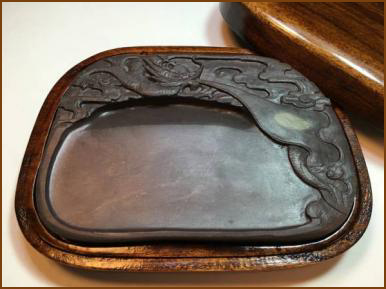
. . . CLICK here for Photos !
Kinoshita Choshoshi see below
:::::::::::::::::::::::::::::::::::::::::::::::::::::::::::::::::::::::::::::::::::::::::::::::::::
KIGO with the Inkstone
hatsu suzuri 初硯(はつすずり) first (use of the) inkstone
kigo for the New Year
suzuri ishi toru 硯石取る (すずりいしとる)
collecting stones for inkstones
Tosa no umi ni suzuri ishi toru
土佐の海に硯石取る(とさのうみにすずりいしとる)
collecting stones for ink stones along the beach of Tosa
kigo for late spring
. . . CLICK here for Photos !
 In former times it was the custom along the coast of Tosa (Shikoku) on the day of jooshi 上巳 (the third day of the third month of the Asian lunar calender, the Hinamatsuri Doll Festival day) to go out to the flatlands and collect stones suitable to make inkstones.
Inkstones from Tosa are famous to our day.
suzuri arai 硯洗 (すずりあらい) washing of the inkstone
suzuri arau 硯洗う(すずりあらう)to wash the inkstone
tsukue arau 机あらう washing the table
kigo for early autumn
On the day before Tanabata, the Star festival on the seventh day of the seventh month (of the Asian lunar calendar) it was a custom to wash your inkstone and clean the tabel before writing your wish to hang on the Tanabata bamboo pole.

西山芳園 "七夕硯洗之図"
芦屋市立美術博物館
Nishiyama Hooen "Washing the ink stone for Tanabata"
Museum of Art, Ashia Town.
. Star Festival (Tanabata 七夕) .
:::::::::::::::::::::::::::::::::::::::::::::::::::::::::::::::::::::::::::::::::::::::::::::::::::
An inkstone
is literally a stone mortar for the grinding and containment of ink. Traditional Chinese ink was usually solidified into sticks for easier transport and preservation. Even a small amount of water could be applied to the end of a stick of ink, and that end would be ground with the flat surface of the ink stone. A larger quantity of ink could be ground from a small pool of water placed on the inkstone. Water could be stored in a water-holding cavity on the inkstone itself, as was the case for many Song Dynasty (960-1279) inkstones. The water-holding cavity or water reservoir in time became an ink reservoir for later inkstones. Water was usually kept in a ceramic container and sprinkled on the inkstone.
The inkstone, together with the ink brush, ink (stick) and paper, are the four writing implements traditionally known as the
Four Treasures of the Study.
© More in the WIKIPEDIA !
:::::::::::::::::::::::::::::::::::::::::::::::::::::::::::::::::::::::::::::::::::::::::::::::::::::::
Large replica of a suzuri ink stone, Nanzen-ji temple.
南禅寺の硯


- Photos by Elaine Andre

- Reference -
*****************************
Worldwide use
*****************************
Things found on the way
Inkstone with Daruma Face


Photos from my friend Ishino
About 17 cm long and 12 cm wide.
:::::::::::::::::::::::::::::::::::::::::::::::::::::::::::::::::::::::::::::::::::::::::::::::::::::
達磨大師硯 Inkstone with Daruma

dervish dance -
the sound of grinding circles
my suzuri
- Shared by Elaine Andre -
Haiku Culture Magazine, 2013
:::::::::::::::::::::::::::::::::::::::::::::::::::::::::::::::::::::::::::::::::::::::::::::::::::::
. List of Edo craftsmen 江戸の職人 .
suzurishi 硯師 making stones to rub ink
Until the Edo period, most ink stones had been imported from China. But now craftsmen begun to create their own work, as more townspeople people tended to write and were in need of cheap utensils.
The stones came from Yamaguchi: akama ishi赤間石, Yamanashi:amabata ishi 雨畑石, Aichi:鳳来寺石 Horaiji ishi and Tohoku, especially Iwate.
Cutting a natural stone was hard work.

source : kiyond.blogspot.jp/2011
Smoothing the surface of an inkstone 硯切り was again hard work for dilligent craftsmen.

source : k3.dion.ne.jp/~edo-cad/suzuri_kiri
The part where the ink liquid is finally collected is called
suzuri no umi 硯の海 "the sea of the inkstone".
This part had to be scrubbed with a special long chisel (ノミ)tool.

CLICK for more tools of the trade !
- quote -
Shiunseki-suzuri 紫雲石硯 Shiunseki Inkstone
Shiunseki Suzuri or Shiunseki Inkstone is an inkstone produced in Ichinoseki City and Oofunado City of Iwate Prefecture and is made from stone called Shiunseki that has a distinctive texture.
The origin of the inkstone dates back to Kamakura period when a monk who, on his travels, dropped by Chouan-ji Temple in Oofunado City and found a shiunseki stone at the bottom of a nearby river and used the stone as an inkstone. The monk later took the stone back to Kamakura and dedicated it to a Shogun at that time. With its beautiful looks, the inkstone was named Shiunseki (purple cloud) Inkstone.

Shiunseki stone is a schalstein extracted from soil more than 400 million years old from Kitakami mountain. The stone has a red-purplish color similar to azuki red beans. Also many of them have characteristic cloud-shaped patterns or greenish spots.
In addition to elegance and smoothness, the surface of the stone has fine and minute imperfections that allow ink-cake to be ground finely. These characteristics make Shiunseki stone the most suitable stone for inkstone.
There was a time when mass production of machine made inkstone was widespread and handmade Shiunseki Inkstone making waned. However, after World War II, artisans began turning their attention back to the craft of hand making the stone. Shiunseki Inkstone is still now being produced with the same quality as its legend suggests.
- source : nippon-kichi.jp/article -
:::::::::::::::::::::::::::::::::::::::::::::::::::::::::::::::::::::::::::::::::::::::::::::::::::::
February 2012
The Tohoku region has been hard hit by the earthquake
on March 11, 2011.
. Ink stones from Ogatsu town, Ishinomaki 石巻 雄勝町 .
. Japan after the BIG earthquake March 11, 2011 .
*****************************
HAIKU
. Matsuo Basho 松尾芭蕉 - Archives of the WKD .
硯かと拾ふやくぼき石の露
suzuri ka to hirou ya kuboki ishi no tsuyu
Saigyo's inkstone?
I pick it up -- dew
on the concave rock
Matsuo Basho, trans. Barnhill
:::::::::::::::::::::::::::::::::::::::::
Compiled by Larry Bole
Translating Haiku Forum
David Coomler discusses Reichhold's translation of this haiku to point out what he sees as shortcomings in her translations of Basho's haiku.
http://hokku.wordpress.com/2008/09/25/raking-reichhold-over-the-coals/
Here is Reichhold's translation:
"inkstone"
picking up a hollow stone
with dew
Coomler says of Reichhold's translation:
Again we have the awkwardness due to missing punctuation. Is someone
using dew to pick up a hollow stone? One would be justified in
wondering how that is accomplished. Of course one will puzzle it out
and eventually decide the dew must be in the stone, but the
momentary confusion caused by absent punctuation is endemic in
Reichhold's translations.
[end of excerpt]
I have no trouble with Coomler's point about how easy it is to read
the translation as meaning that someone is "using dew to pick up a
hollow stone." However, I'm not so sure that the problem lies with
lack of punctuation.
What if one were to modify Reichhold's translation to read like this:
"inkstone"
picking up a hollow stone
with dew on it
or even like this;
"inkstone"
I pick up a hollow stone
with dew on it
I think both of these alternatives make it clear what the action is
even without punctuation.
Now, for another point I would like to discuss, I was going to re-
visit Mr. Coomler's essay on Reichhold, for which I have posted the
url above, which Gabi posted in a previous post here. However, it
appears that Mr. Coomler has removed his essay about Ms. Reichhold's
translations of Basho from his website.
I do remember however, that Mr. Coomler did not address the fact that
Ms. Reichhold puts the word 'inkstone' inside of quotations marks in
her translation: "inkstone." This seems such a striking choice by Ms.
Reichhold that one wonders why she made this translation choice, and
what it means.
I am now relying on the quotes from Mr. Coomler's essay that Gabi used in her previous post on this topic:
In order to get at what Bashô really meant by this verse, we first of all have to know that Reichhold left out something very important — the significance of the particle ka in the original, which makes the verse a "question" hokku. Bashô is not making a statement, but is really asking,
"Is this the inkstone I have picked up?"
[end of excerpt]
I suspect that Ms. Reichhold didn't ignore 'ka', but decided to
translate it differently, in conjunction with the following 'to', to
become the quotation marks (" ") around the word 'inkstone'. Perhaps
she was using the aspect of 'to' that Henderson mentions in his
definition:
It's most common use in haiku is to indicate "that" one said or did,
or "thus" one spoke or acted.
[end of excerpt]
Could one make a case for Ms. Reichhold using the "said" or "spoke"
aspect of 'to' to make her choice of using quotation marks? Here is
Ms. Reichhold's literal translation:
suzuri ka to / hirou ya kuboki / ishi no tsuyu
inkstone <> (quotation) / pick up <> hollow / stone's dew
Although most English books about haiku flat-out define 'ka' as "a verbal question mark" (to quote Henderson), I have found a Japanese critic who implies that it is not so clear-cut.
Kooji Kawamoto, in his book "The Poetics of Japanese Verse," gives two of Basho's haiku which use the particle 'ka':
mugimeshi ni yatsururu koi ka neko no tsuma
Has it been from love as well as barley rice
that it has grown so scrawny?
cat's mate.
長嘯の墓もめぐるか鉢叩き
Chooshoo no haka mo meguru ka hachitakaki
Have his rounds taken him
as far as Chooshoo's tomb?--
priest seeking alms.
Of the use of 'ka' in these haiku, Kawamoto says:
As illustrated by these examples, it is not easy to tell right away whether the final particle 'ka', so favored by Basho, was used as an interrogative or emotive particle, and this indeterminacy adds tension to the poems.
[end of excerpt]
I would ask Ms. Reichhold if she was interpreting 'ka' as an "emotive particle" in her translation.
I want to end by addressing one more of Mr. Coomler's points about Basho's 'inkstone' haiku.
Mr. Coomler says:
"It is not a very good verse and it requires knowing the background, but nonetheless it has meaning that Reichhold fails to transmit."
I contend that, although it is not a great verse, it is better than Mr. Coomler's opinion of it.
It contains what to me is a healthy nostalgia. Who among us doesn't treasure some keepsake of a loved one or, lacking a keepsake, wish we had one? Basho attempts to imaginatively bond with his most significant cultural hero, Saigyo, by imagining that a hollowed-out stone with dew in the hollow might be the actual hollowed-out stone that Saigyo is said to have used for an inkstone when he was living for a while in seclusion at Futami, near Ise. I find this haiku to be a very moving expression of Basho's sentiment.
Another haiku by Basho with a similar sentiment:
Saigyoo no waraji mo kakare matsu no tsuyu
Saigyoo's sandals:
hang them as well
with the pine's dew
Basho
Tr. Barnhill
. Matsuo Basho 松尾芭蕉 - Archives of the WKD .
. Kinoshita Chooshooshi 木下長嘯子 / 長嘯
Kinoshita Choshoshi .
(1569 - 1649)
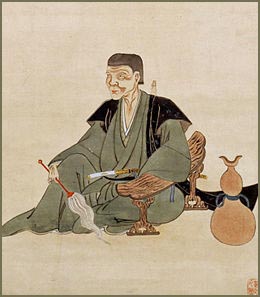
Kinoshita Katsutoshi 木下勝俊
quote
Seiryu-En . . . the place where long ago Kinoshita Choshoshi had his retreat. A Momoyama waka poet, Kinoshita Choshoshi was the nephew-in-law of Toyotomi Hideyoshi and had exchanges with Confucianist Hayashi Razan, devotees of the way of tea, tea master and garden architect Kobori Enshu, as well as with many nobles of the court.
He studied waka poetry with Hosokawa Yusai, an initiate of the traditions of the Kokinshu collection of 'ancient and modern' poems. From the early modern age to more recent times this has been the stage for such activities as the creation of paintings and literary works, or tea gatherings, and many writers and artists have gathered here.
source : www.seiryu-en.com
Chooshoo no haka mo meguru ka hachitakaki
Written on the 24th day of the 12th lunar month, 1689 元禄2年
Basho had visited Kyorai to see the procession of the monks.
They do it for 48 days, starting on the 13th day of the 11th lunar month.
are they walking around
the grave of Choshoshi ?
Hachitataki ceremony
Tr. Gabi Greve
. Hachi Tataki, hachitataki 鉢叩 鉢敲, 鉢扣
First yearly Memorial Service for Kuuya Shoonin .
kigo for the New Year
a waka by Choshoshi
鉢叩き暁方の一声は冬の夜さへも鳴く郭公
hachitataki akegata no hitokoe wa
fuyo no sae mo naku hototogisu
itinerant priest
your lone voice toward dawn -
a hotogisu
that sings
even on a winter's night
Tr. Cheryl A. Crowley
. Kobayashi Issa 小林一茶 in Edo .
いうぜんとして山を見る蛙哉
iuzen to shite yama o miru kawazu kana / yūzen to
motionless
frog gazes calmly
at the mountain
This hokku is from the end of the first lunar month (February) in 1813, a few days after Issa had reached a settlement with his half brother that divided up their father's inheritance, including the family house, equally between them. The headnote refers to the famous warrior waka poet Kinoshita Chōshōshi (1569-1649), who wrote about an imaginary court waka contest between fifteen pairs of different insects, with the fifteen winners being chosen by a judge who was a large frog. The contest was published as a book, Insect Waka Contest, sometime between 1624 and 1644, and Issa must have read a copy. In the headnote he praises a frog he sees sitting calmly and gazing at a mountain in the distance. In this humorous headnote Issa tells the unmoving frog with its imposing eyes and lofty gaze how much he respects him for being a descendant of a fictional frog chosen by Chōshōshi for its ability to understand waka, thus implying that the croaking songs of this actual frog, too, are outstanding frog waka.
The gaze of the frog also has spiritual implications, as can be seen from a further allusion, this one to a poem by the Chinese poet Tao Qian (365–427), also known as Tao Yuanming. Tao Qian was a minor official who gave up his boring work and became a farmer in a country town. Strongly influenced by Daoism, he spent most of his time writing poems and drinking with his friends, and his poems give off a strong feeling of a free spirit carrying on a dialog with both nature and other free spirits. Issa alludes to the fifth poem in a series of poems entitled "Twenty Poems After Drinking Wine," a poem most of his readers would have been familiar with, since it was very famous in both China and Japan.
Since Issa refers to the whole poem, here is my translation:
I made my hut where other people dwell
and yet I hear no noise of horses or of carts.
You ask, how could this be?
My mind detached, I live in far-off places.
As I pick chrysanthemums by the eastern hedge
my calm gaze reaches a distant mountain to the south.
The mountain air is marvelous in sunset light
and birds fly back together to their nests.
Within all this are signs of the truth.
When I try to explain, I've already forgotten words.
One reason the poem is so famous is that it is able to show what it is doing even though it can't explain itself. In the fourth line the detached mind of the poet allows him to live in remote seclusion even though he lives surrounded by people in a town, and in line six "distant" returns to "detached" in line four and suggests that the detached spiritual gaze of the poet allows his mind to visit the distant mountain, causing the reader in Chinese to feel a double image in which the poet gazes at the mountain in an unattached way that allows him to travel to it. The grammar allows this double-vision to be performed by readers before they can rationally delete the second image from their minds, since normally, of course, seeing is not traveling. The next two lines further suggest that far is also near, that Tao Qian has gone to the mountains and is breathing the mountain air and viewing the sunset and birds at fairly close range. Thus Tao Qian becomes fused with the mountain, as if he were returning back to his spiritual home or "nest" there. Tao Qien leaves a further hint by having this vision occur while he is picking chrysanthemums. That is, he is only able to have visions when he isn't trying to see them, or, as the last line says, when he has forgotten words. He seems to be urging readers to leave logic and ordinary meanings behind when they read his poems. Issa was a careful reader of classical Chinese and Japanese literature, so Tao Qian's paradoxical approach was surely intuitively apparent to him.
By quoting part of Tao Qian's Chinese poem, Issa, as so often, is able to bring together opposite images or registers, here mixing vision with earthy humor, sublimity with irony. On the one hand, he praises the poetic sensibility of the frog using grandiloquent rhetoric that suggests the frog's posture is in one sense pompous and vain, while on the other hand he compare's the frog's big-eyed vision with Tao Qian's, implying that the frog has become one with the mountain it watches so intensely and that its unmoving posture suggests it is the unmoving mountain, or at least a smaller frog-mountain version of the mountain. This contradiction seems to be the point of Issa's hokku, as it is with so many of his hokku, many of which are self-ironic. The image of the frog here and the image of the returning birds in Tao Qian's poem would certainly fit with Issa's own mood after finally receiving his half of his father's house and realizing that he would soon be able to return to his hometown to live. The image of Issa talking with a frog and staring at one of the high mountains near his hometown and feeling at one with it may lie behind this hokku, as well as the image of Issa acknowledging that while his humble hokku are not as elegant as classical waka they nevertheless are capable of dealing with important aspects of everyday life that are both ridiculous and inspiring at the same time.
The above version of the hokku is found in Issa's Seventh Diary from 1813, but he uses the hokku again in Year of My Life, as if it had been written in 1819, the year evoked in Year of My Life. The hokku must have meant a lot to him, and he wanted use it again in Year of My Life after a passage about a funeral for a frog. Issa uses the same headnote about a frog judging waka in both 1813 and 1819. In Year of My Life, however, he also mentions that frogs were believed to have various spiritual and magical powers in ancient times and that he enjoys sitting together with them in the cool evening air.
Chris Drake
.............................................................................

source : www.tokeiji.com
inkstone box from temple Tokei-Ji, Kamakura
杜鵑鳴く音や古き硯箱
ほととぎす鳴く音や古き硯箱
hototogisu naku ne ya furuki suzuri-bako / suzuribako
a hototogisu
is singing a song - his old
inkstone box
Tr. Gabi Greve
Summer 1692, 9th day of the 4th lunar month - 元禄5年4月9日
This is the first death anniversary of his disciple Okamura 岡村不卜Fuboku in Edo.
Basho was very close to Fuboku and has also written a hokku for the death anniversary of his mother.
Doomyooji 道明寺 Domyo-Ji
. WKD : for the Mother of his disciple Fuboku .
An inkstone box was a very treasured utensil, especially for a haikai master travelling a lot.
This hokku has the cut marker YA in the middle of line 2.
the sound of a
cuckoo singing -
an old inkstone box
Tr. Barnhill
cuckoo
whose old singing voice
in the inkstone case
1692 summer.
Fuboku was a friend of Basho and Kinpu. The calling of the cuckoo bird was supposed to make a person miss the past. The cuckoo is a metaphor for Fuboku. There is also the idea that the voice of the bird is in the old box and the words no longer written by the man remain in the inkstone."
Tr. Reichhold
Cultural Keywords used by
. Matsuo Basho 松尾芭蕉 - Archives of the WKD .
Okamura Fuboku 岡村不卜
Ichiryuuken Fuboku 一柳軒不卜
(1632 - 1691) - 元禄4年4月9日
Haikai poet in Edo.
Student of Ishida Mitoku 石田未得 of the Teimon school.
:::::::::::::::::::::::::::::::::::::::::::::::::::::::::::::::::::::::::::::::::::::::::::::::::::
. Kobayashi Issa 小林一茶 in Edo .
云訳の手がたに氷る硯かな
iiwake no tegata ni kooru suzuri kana
upon writing a note
of apology, ice
in my ink-stone
(Tr. David Lanoue)
:::::::::::::::::::::::::::::::::::::::::::::::::::::::::::::::::::::::::::::::::::::::::::::::::::
. Yosa Buson 与謝蕪村 in Edo .
菊の露受けて硯の命かな
kiku no tsuyu ukete suzuri no inochi kana
chrysanthemum dew
is the life blood
of this ink stone . .
Tr. Gabi Greve
The cut marker KANA is at the end of line 3.
. kiku no tsuyu 菊の露 dew on chrysanthemums .
kigo for autumn
山寺の硯に早し初氷
yamadera no suzuri ni hayashi hatsugoori
the ink stone
of this mountain temple has it early -
the first ice
Tr. Gabi Greve
雪信が蝿打ち払う硯かな
yukinobu no hae uchi-harau suzuri kana
Yukinobu
shooing flies off
the inkstone
Tr. Robin D. Gill
. Kano Yukinobu - Lady Kiyohara Yukinobu 清原 雪信 . (1643 - 1682)
:::::::::::::::::::::::::::::::::::::::::::::::::::::::::::::::::::::::::::::::::::::::::::::::::::::
:::::::::::::::::::::::::::::::::::::::::::::::::::::::::::::::::::::::::::::::::::::::::::::::::::::
若楓影さす硯あらひけり
waka-kaede kage sasu suzuri araikeri
young maple leaves
cast a shadow
I wash my inkstone
. Mizuhara Shuoshi 水原秋桜子 .
*****************************
Related words
***** Calligraphy
. Ogawa Haritsu 小川破笠 and his inkstone boxes .
(1663 - 1747)
:::::::::::::::::::::::::::::::::::::::::::::::::::::::::::::::::::::::::::::::::::::::::::::::::::::
. Tengupedia - 天狗ペディア - Tengu ABC-List .
Tengu no suzuri iwa 天狗の硯岩 Inkstone Rock of a Tengu
:::::::::::::::::::::::::::::::::::::::::::::::::::::::::::::::::::::::::::::::::::::::::::::::::::::
[ . BACK to DARUMA MUSEUM TOP . ]
[ . BACK to WORLDKIGO . TOP . ]
- #suzuri #inkstone -
:::::::::::::::::::::::::::::::::::::::::::::::::::::::::::::::::::::::::::::::::::::::::::::::::::::
9/22/2008
Praise (homekotoba)
[ . BACK to WORLDKIGO TOP . ]
:::::::::::::::::::::::::::::::::::::::::::::::::::::::::::::::::::::::::::::::::::::::::::::::::::
Praize (homekotoba)
***** Location: Japan
***** Season: Non-seasonal Topic
***** Category: Humanity
*****************************
Explanation
There are many ways of praize in Japanese.
Inspired to pick it up by the following article:
:::::::::::::::::::::::::::::::::::::::::::::::::::::::::::::::::::::::::::::::::::::::::::::::::::
quote
Insults come as second nature to humans
By ROGER PULVERS
There are two common ways to say "compliment": ohome no kotoba (おほめの言葉) and oseiji (お世辞). The ohome in the former comes from the verb homeru (ほめる), which means "to praise." The latter means flattery and can be ironical. Osejijzu na hito (お世辞上手な人), or someone good at oseiji, is an unctuous flatterer.
But let us assume that your compliments are not of the latter variety and you have a friend whose child is as smart as a whip. Nothing will put you into your friend’s good books more quickly than Orikōsan desu ne (お利口さんですね, What a clever child!).
If you call your friend a yarite (やり手), you are praising her for being a mover and a shaker, although my old dictionary defines yarite as "a man of ability, a capable man." A woman can be a yarite, too, dictionaries to the contrary notwithstanding.
The word bijin (美人, beautiful woman) is still in common usage, and a sugoi bijin (すごい美人) is a knockout, or what my dad used to call a "lollapalooza." A man can also be a lollapalooza if he’s otokomae (男前, handsome) or kakkoii (カッコいい, good-looking, cool). If you say about someone that they are migi ni deru mono wa nai (右に出るものはない), it means that they are unsurpassed, the tops. This is because Japanese lists go from right to left, so naturally there is no one to the right of, that is, "above," them.
That person may well be an ōmono (大物), or a big shot, a big cheese. Generally people who are big shots harbor a secret to their success. You might say they are sumi ni okenai (隅におけない), which means that there’s more to them than meets the eye. Sumi ni okenai literally means they "cannot be cornered." This is the kind of coincidence of meaning that occurs rarely in two languages.
Two very common phrases used as compliments are erai! (偉い) and taishita mon da (大したもんだ). These have a multitude of English equivalents, depending on context, such as "You’re really something!" "That’s amazing!" or "Awesome!"
The character sai (才) denotes talent. A person with a good head for business is shōsai no aru hito (商才のある人). A person who is brilliant at something is a tensai (天才), or genius. And a woman — it must be a woman in this case — who has wit to match her beauty may be described as saishoku kenbi (才色兼備). The sai is the character seen above, and the shoku is 色, the character for color that also suggests charm, beauty and eroticism. That’s a mouthful for anybody’s tongue.
Suteki (素敵) is a catchall for all kinds of expressions, from fantastic and amazing to brilliant and stunning. If someone looks you in the eyes and says this one word, it means love.
Rippa (立派) is another word used as a compliment. It also means brilliant and superb. It is often used to describe something that a person has achieved or attained. If you add the honorific prefix go to rippa, you get gorippa (ご立派), a bon mot expressing admiration for something or someone. Gorippa da! (ご立派だ) can mean "I really admire you!" and "Bravo!"
But you must be a bit careful when the level of compliments is raised to downright flattery. Japanese people can be quite ironical when they ki no nai homekata de kenasu (気のないほめ方でけなす), or damn with faint praise. If someone looks at the miserable sushi you have made as it falls apart on the plate and says Ojōzu desu ne! (お上手ですね, Oh, how very skillful of you!), get a grip on yourself and don’t fall for it.
This business of damning with faint praise brings me to next week’s topic, that of the art of the bujoku (侮辱), or insult, which for us humans may be akin to "doin’ what comes naturally." If I urge you to read this column in next week’s Japan Times, I do not mean to insult your intelligence . . . not until next week, at least.
source : Japan Times, September 2008
:::::::::::::::::::::::::::::::::::::::::::::::::::::::::::::::::::::::::::::::::::::::::::::::::::
Ojozu desu neeee (o-joozu desu ne) ... how many time have I heared this as a flattery to my simple Japanese in the beginning years (nowadays, nobody says it any more). The longer the eeeee, the worse my Japanese, I figured.
*****************************
Worldwide use
*****************************
Things found on the way
*****************************
HAIKU
そうめんの流れに 箸の上手下手
soomen no nagare ni hashi no joozu heta
somen noodles flow by
and some use chopsticks
skillfully, unskillfully
Yamada Yoshiyuki 山田良行
Soomen, somen noodles 索麺 WASHOKU
:::::::::::::::::::::::::::::::::::::::::::::::::::::::::::::::::::::::::::::::::::::::::::::::::::
poor westerner,
he grows thin eating
with chopsticks!
robert d. wilson, September 2008
*****************************
Related words
***** WASHOKU ... Japanese Food SAIJIKI
::::::::::::::::::::::::::::::::::::::::::::::::::::::::::::::::::::::::::::::::::::::::::::::::::
9/15/2008
Omoshiro ya
[ . BACK to WORLDKIGO TOP . ]
:::::::::::::::::::::::::::::::::::::::::::::::::::::::::::::::::::::::::::::::::::::::::::::::::::
How interesting ! (omoshiro ya)
***** Location: Japan
***** Season: Non-seasonal Topic
***** Category: Humanity
*****************************
Explanation
omoshiro ya ... a first line used by Shiki for some haiku.
omoshiroi, おもしろい (面白い) can have many nuances in Japanese, according to the situation.
interesting, amusing, wondrous, entertaining, funny, enjoyable, strange, weird, exciting ...
Kyoomibukai きょうみぶかい(興味深い)is more often used for something interesting in an educational context.
Once I said to the priest, the spring festival was omoshiroi. He thought I should have used kyoomibukai, since it was not funny but a culturally rich old festival.
:::::::::::::::::::::::::::::::::::::::::::::::::::::::::::::::::::::::::::::::::::::::::::::::::::
Thanks to Larry Bole for bringing this topic to discussion !
Happy Haiku Forum / Spetember 16, 2008
*****************************
Worldwide use
schön. interessant. amüsant; lustig; spaßig; ulkig; drollig.
angenehm; unterhaltend; unterhaltsam.
*****************************
Things found on the way
*****************************
HAIKU
Two haiku by Masaoka Shiki 正岡子規
面白や月に山椒の皮剥げば
omoshiro ya tsuki ni sanshoo no kawa hageba
how interesting !
peeling the bark off the mountain pepper
in moonshine
Tr. Gabi Greve : "Mountain pepper"(sanshoo)
面白や馬刀の居る穴居らぬ穴
omoshiro ya mate no iru ana iranu ana
how interesting !
a hole with a razor shell
a hole without one
Tr. Gabi Greve : razor shell (mate)
:::::::::::::::::::::::::::::::::::::::::::::::::::::::::::::::::::::::::::::::::::::::::::::::::::
omoshiro ya shigure suru yo no yabure-an
How entertaining
to be in a dilapidated hut
on the night of 'shigure'!
Kyuukousai, found in Sasaki Sanmi
Chado the Way of Tea: A Japanese Tea Master's Almanac
Discussion about "omoshiroya" : Translating Haiku Forum
Larry Bole
:::::::::::::::::::::::::::::::::::::::::::::::::::::::::::::::::::::::::::::::::::::::::::::::::::::

source : 天象堂画廊
おもしろや ことしの春も 旅のそら
omoshiro ya kotoshi no haru mo tabi no sora
how amusing
this year in spring
the skies of a journey
Matsuo Basho
source : tr. and following note by Jane Reichhold
how strange is life ! ..... or ... how exciting !
this year in spring
I will be travelling again
Free translation by Gabi Greve
MORE - emotions expressed directly - Emotionen - by
. Matsuo Basho 松尾芭蕉 - Archives of the WKD .
*****************************
Related words
***** Emotions expressed in Haiku
[ . BACK to DARUMA MUSEUM TOP . ]
[ . BACK to WORLDKIGO . TOP . ]
:::::::::::::::::::::::::::::::::::::::::::::::::::::::::::::::::::::::::::::::::::::::::::::::::::::
7/13/2008
Tsujido Roadside Sanctuary
[ . BACK to WORLDKIGO TOP . ]
:::::::::::::::::::::::::::::::::::::::::::::::::::::::::::::::::::::::::::::::::::::::::::::::::::
Tsujido Roadside Sanctuary (tsujidoo)
***** Location: Japan
***** Season: Non-seasonal Topic
***** Category: Humanity
*****************************
Explanation
Here is a haiku by Yosa Buson which started the quest.
. Yosa Buson 与謝蕪村 in Edo .
辻堂の仏にともすほたる哉
tsujidoo no hotoke ni tomosu hotaru kana
at the wayside shrine
the Buddha is alight
with fireflies . . .
or
the stone Buddha
at the roadside shrine is alight
with fireflies . . .
Translators problems as usual :
Is it one Buddha or more, like the "Six Jizo Statues", we often find at a crossroad?
Is it one firefly or more?
I tend to see more than just one, as I always do here in our fields.

tsujidoo 辻堂 a small building or hall (doo) at a crossroads (tsuji), where the Deities have to watch over the travellers.
The six Jizo are maybe the most popular deities at crossroads, often as stone statues without any hall to protect them. See link below.
:::::::::::::::::::::::::::::::::::::::::::::::::::::::::::::::::::::::::::::::::::::::::::::::::::::
Tsujidoo 辻堂 Tsujido
a town on the Shonan beach, near Fujizawa
This is an old postal town of the Tokaido route from Kyoto to Tokyo.
Tsujido, More in the WIKIPEDIA !
Maybe Buson was here ?
:::::::::::::::::::::::::::::::::::::::::::::::::::::::::::::::::::::::::::::::::::::::::::::::::::
Tsujindoo 辻堂(つじんどう)

Tsujindoo Yakebotoke 「辻堂焼け仏」
A stone monument of a "burned Buddha"
near Temple Joruji in Nara. The wooden hall, where the memorial had been sheltered, burned down long ago and since then the stone is exposed to nature. The stone is about 2 meters high. Both sides of the stone still show the remains of the burning.
source : urano.org/kankou
Maybe Buson was here ?
*****************************
Worldwide use
*****************************
Things found on the way
. Doosojin 道祖神 Dosojin, the Wayside Gods

. Roku Jizoo, Rokujizoo (六地蔵)
Six Jizo statues at the crossroads
guardian deities of the Six Realms of the afterlife

source : blog.goo.ne.jp/fineblue7966
Tsujido with Jizo at Nakanokawa 中ノ川辻堂の地蔵石仏
. Jizoo Bosatsu (Kshitigarbha) 地蔵菩薩 Jizo .
*****************************
HAIKU
辻堂に死せる人あり麦の秋
tsujidoo no shiseru hito ari mugi no aki
at the roadside shrine
there have been people dying ...
autumn of the barley
Buson or Kikaku ? 其角と蕪村
http://www.freeml.com/bl/2766/463496/
Poor people wandering along in Japan often took shelter in these small halls and some died for want of food and energy to carry on.
- - - - - Further discussion of this haiku :
. Yosa Buson 与謝蕪村 in Edo .
:::::::::::::::::::::::::::::::::::::::::::::::::::::::::::::::::::::::::::::::::::::::::::::::::::
tsujibotoke 辻仏 "Buddha by the roadside"

nobotoke 野仏 "Buddhas in the wilderness"
十五夜も十六夜も雨辻仏
juugoya mo izayoi mo ame tsujibotoke
full moon night
and the next night too in rain -
roadside Buddhas
Kezuka Shizue 毛塚静枝
. Moon in autumn (aki no tsuki)
- - - - -
. Kobayashi Issa 小林一茶 in Edo .
野仏のぼんのくぼより梅の花
no-botoke no bon no kubo yori ume no hana
plum blossoms fall
from the nape of the of the
field Buddha's neck
Tr. Gabi Greve
.................................................................................
早春の空の御機嫌辻仏
山岡律子
松とれてなで肩となる辻仏
加藤三陽
繭玉を手にせり蜑が辻仏
水原秋櫻子
辻仏灯して朧ふやしけり
毛塚静枝
source : 辻仏 and haiku
*****************************
Related words
野仏に紅葉の降るる山暮らし
nobotoke ni momiji no fururu yamagurashi
red maple leaves
fall on the stone Buddha -
my mountain life
Gabi Greve
***** Buddha statues in the fields (nobotoke)
:::::::::::::::::::::::::::::::::::::::::::::::::::::::::::::::::::::::::::::::::::::::::::::::::::::::
[ . BACK to DARUMA MUSEUM TOP . ]
[ . BACK to WORLDKIGO . TOP . ]
- tsujido #nobotoke
:::::::::::::::::::::::::::::::::::::::::::::::::::::::::::::::::::::::::::::::::::::::::::::::::::::::
6/19/2008
Murasaki the Color
[ . BACK to WORLDKIGO TOP . ]
:::::::::::::::::::::::::::::::::::::::::::::::::::::::::::::::::::::::::::::::::::::::::::::::::::
Murasaki, the Color
***** Location: Japan
***** Season: Non-seasonal Topic
***** Category: Humanity
*****************************
Explanation
Genji Monogatari and Murasaki Shikibu ... 紫式部
"月百姿 石山月" Lady Murasaki at Ishiyama
Tsuki Hyakushi
by Tsukioka Yoshitoshi 月岡芳年 (1839-1892)
One Hundred Aspects of the Moon ... and more kigo
The Beginning of our MURASAKI discussion !
:::::::::::::::::::::::::::::::::::::::::::::::::::::::::::::::::::::::::::::::::::::::::::::::::::
It started with this woodblock print and the question:
Lady Violett or Lady Purple?
A quick google seach found it all ...
Lady Murasaki was nicknamed "Murasaki" ("purple wisteria blossom")
The name Lady Murasaki, literally "Violet" ...
.... "Murasaki" (Purple, although "Violet" may fall more comfortably on the English ear)
:::::::::::::::::::::::::::::::::::::::::::::::::::::::::::::::::::::::::::::::::::::::::::::::::::::
quote
Violet is a spectral color (approximately 420 - 380 nm), of a shorter wavelength than blue, while purple is a combination of red and blue or violet light. The purples are colors that are not spectral colors - purples are extra-spectral colors.
In fact, purple was not present on Newton's color wheel (which went directly from violet to red), though it is present on modern ones, between red and violet. There is no such thing as the "wavelength of purple light"; it only exists as a combination.
The actual color of Tyrian purple, the original color purple from which the name purple is derived, is the color of a dye made from a mollusk that, because of its incredible expense (many times more expensive than gold), in classical antiquity became a symbol of royalty because only the very wealthy could afford it. Therefore, Tyrian purple is also called imperial purple.
More in the Wikipedia
:::::::::::::::::::::::::::::::::::::::::::::::::::::::::::::::::::::::::::::::::::::::::::::::::::::
The origin of the word MURASAKI 紫
This was used for the plant of this name, which grew in large groups (mure ... mura) mure ga saku, mura saku, mura saki ...
or
one flower grew in many shades of murasaki (this refers to a type of hydrangea), so the color has shades (mura) (mura ni natte saku ... ... mura saki)
The pigment MURASAKI is taken from the root of the plant.
http://gogen-allguide.com/mu/murasaki.html
paapuru パープル
What was the Japanese for PURPLE
before the advent of using katakana ?
:::::::::::::::::::::::::::::::::::::::::::::::::::::::::::::::::::::::::::::::::::::::::::::::::::::
Flowers of the murasaki family
ムラサキ科 murasaki ka
Boraginaceae
The Color Code for Japanese Traditional MURASAKI shades
I hope your monitor shows the fine gradations !
main murasaki 本紫 ほんむらさき #65318e
murasaki 紫 むらさき #884898
Edo murasaki 江戸紫 えどむらさき #745399
murasaki dark kon 紫紺 しこん #460e44
blue murasaki ao 青紫 あおむらさき #674598
deep murasaki 深紫 ふかむらさき #493759
wisteria murasaki fuji 藤紫 ふじむらさき #a59aca
murasaki shion color 紫苑色 しおんいろ #867ba9
Kyoto murasaki 京紫 きょうむらさき #9d5b8b
"young murasaki" wakamurasaki
若紫 わかむらさき #bc64a4
beni murasaki 紅紫 べにむらさき #b44c97
plum murasaki 梅紫 うめむらさき #aa4c8f
light murasaki 浅紫 あさむらさき #c4a3bf
murasaki chrystal 紫水晶 むらさきすいしょう #e7e7eb
Japanese Color Codes Click here for color boxes.
:::::::::::::::::::::::::::::::::::::::::::::::::::::::::::::::::::::::::::::::::::::::::::::::::::::
Compiled by Larry Bole :
Murasaki (紫) is the Japanese word for the colour purple.
Other translations include Lavender, as used by Edward Seidensticker in his English version of the Genji Monogatari; Violet; and Violet Root, which in Japanese poetry denotes Constancy. Genji, in [a poem], names the murasaki or purple gromwell, because its color resembles
the wisteria (in Japanese, fuji) thereby referring to Fujitsubo, "the Lady of the Wisteria Court", a woman he is violently in love with for the first part of the novel. It happens that Fujitsubo is Murasaki's aunt.
Thus, in a word association game very characteristic of Japanese poetry, the similarity between the two colors led to the name Murasaki, perhaps the most illustrious name in Japanese literature.
http://en.wikipedia.org/wiki/Murasaki
Lithospermum purpurocaeruleum or Purple Gromwell is a plant species of the genus Lithospermum. It has been cultivated in Japan since the Nara period for its root, which can be used for herbal medicine and to make dyes.
One Japanese word for the plant, murasaki (紫), inspired the pen name "Lady Murasaki" for the author of The Tale of Genji and is also the source of the general Japanese term for the color purple, murasaki iro (紫色).
The dyes made from its root also had other names, such as shikon (紫 根), but all of them were difficult to work with because of their requirement for an alum-rich mordant and the resulting colors' extreme vulnerability to photobleaching. During the Heian Period, sumptuary laws restricted murasaki-dyed clothing to the Empress and her ladies in waiting.
http://en.wikipedia.org/wiki/Lithospermum_purpurocaeruleum
In Jane Reichhold's book of translation of poetry from The Tale of Genji, "A String of Flowers Untied...: Love Poems from The Tale of Genji," she tends to use the same color translation as Seidensticker does: lavender, although she also uses purple as well.
Reichhold's Chapter 5 is titled,
"Waka Murasaki: Young Lavender."
Here are two translations of poems from the book:
te ni tsumi te
itsushikamo mi n
murasaki no
ne ni kayoi keru
nobe no wakakusa
taking it in hand
may I soon take care of
Murasaki
the root of royal purple
still in the field of young grasses
...Genji begins lessons for Murasaki in poetry and calligraphy. He writes out for her the old poems from the anthologies for her to copy. One day, choosing lavender paper, he wrote the following 'waka' from an unknown author in the 'Kokin Rokujoo'.
shira ne domo
musashino to ieba
kakota re nu
yoshiya sakoso wa
murasaki no yue
though I cannot see it
when one speaks of Musashino
I sigh so deeply
the reason fo this are thoughts
of those grasses of lavender
:::::::::::::::::::::::::::::::::::::::::::::::::::::::::::::::::::::::::::::::::::::::::::::::::::::
In a German dictionary, we find
Purpurfarbe; Violett; Lila.
violett; purpur.
*****************************
Worldwide use
*****************************
Things found on the way
Purple / Violett Daruma Dolls
murasaki daruma
紫 (だるま 。 ダルマ 。達磨)
This is a color of the Feng-Shui system.
Its symbolic meaning is : your wish will be fulfilled, of high rank, supremacy and more.
紫色の福だるまの意味⇒祈願成就・上階級・至高など
© gp-pro
:::::::::::::::::::::::::::::::::::::::::::::::::::::::::::::::::::::::::::::::::::::::::::::::::::::
Purple Papermachee Doll
Little Netsuke
Click on the photos for more.
*****************************
HAIKU
Two haiku by ISSA
紫の袖にちりけり春の雪
murasaki no sode ni chiri keri haru no yuki
scattering onto
my purple sleeves...
spring snow
紫の雲にいつ乗るにしの海
murasaki no kumo ni itsu noru nishi no umi
on purple clouds
when will I set sail?
western sea
This haiku without season alludes to rebirth in the Pure Land, located somewhere in the mythic west.
。。。Tr. David Lanoue
:::::::::::::::::::::::::::::::::::::::::::::::::::::::::::::::::::::::::::::::::::::::::::::::::::
kigo for mid-spring
wakamurasaki 若紫 (わかむらさき) gromwell, stoneseed
lit. "young murasaki", the color mauve, light purple, see above
..... murasaki 紫(むらさき)
Lithospermum erythrorhizon
family Boraginaceae. Herbs or small shrubs.
© More in the WIKIPEDIA !
The Tale of Genji
. Lady Wakamurasaki 若紫 .
:::::::::::::::::::::::::::::::::::::::::::::::::::::::::::::::::::::::::::::::::::::::::::::::::::
kigo for late summer
murasaki 紫草 (むらさき) "Murasaki plant"
hana murasaki 花紫(はなむらさき)
murasaki no hana 紫の花(むらさきのはな)
Lithospermum erythrorhizon
It grows wild in many mountain regions of Japan. The root is used for dyeing and medicine.
*****************************
Related words
***** Colors in Haiku, Traditional Japanese Colors
::::::::::::::::::::::::::::::::::::::::::::::::::::::::::::::::::::::::::::::::::::::::::::::::::


 Posts
Posts


