[ . BACK to WORLDKIGO TOP . ]
:::::::::::::::::::::::::::::::::::::::::::::::::::::::::::::::::::::::::::::::::::::::::::::::::::
Renku, 連句、renga 連歌 : Linked Verse
chain-linked poetry
renga no za 連歌の座 group of friends writing renga
za no bungei 座の文芸 "the literature of a group activity"
literature of shared space, za literature and art
group literature
Please explore this LINK for all the details:
RENKU HOME
William J. Higginson
. LINK and SHIFT - Higginson .

Here I will just collect information as I find them.
:::::::::::::::::::::::::::::::::::::::::::::::::::::::::::::::::::::::::::::::::::::::::::::::::::
A first ku (hokku) that can stand alone, usually with a mention of a special area, an independent hokku, is called
jihokku 地発句(じほっく)
The last ku of a linked verse is "ageku 挙句", and there is a popular Japanese proverb, ageku no hate 挙句の果て, at the last ku, meaning "at last".
Oku no Hosomichi ... 2007. Gabi Greve
......................................................................................
question
what is matsuko ?
a friend asked without any further information.
answer
on first thought, the name of a girl, Pine Girl, Matsuko 松子.
on second thought, inputting the hiragana ma tsu ko まつこ in my wordprocesser, it came up with .. makko まっこ ... words .
The small TSU symbolized only the doubling of the following letter, K.
...//dic.yahoo.co.jp/ search まっこ
But none of these words made sense with respect to haiku or poetry.
Next my friend told me it was supposed to be the last stanza of a renga, a linked verse.
.............................................NOW
matsu 末 seemed to make sense, the end of something, like weekend, shuumatsu 週末.
still the KO 子 was a riddle, ... until it dawned on my, the old solution to many problems, *a spelling mistake * !!!
MA TSU KU まつく ... and here I was MAKKU まっく, 末句, the last verse.
まっく 【末句】―短歌などの、最後の句
.. www.geocities.jp/koterikotte/moji/
.. GOOGLE with "末句" !
This is the short story of a Word Detective.
Hope you enjoyed it. Next time, think . spelling mistake .. in the first place ... grin
Translating Haiku。Gabi Greve
:::::::::::::::::::::::::::::::::::::::::::::::::::::::::::::::::::::::::::::::::::::::::::::::::::::
Question
If renga is written in an international context, what shall we do about the kigo, season words?
Answer
I think in case of RENKU, as the participants are friends and they can agree in advance which saijiki or kiyose to accept and follow, so that should not be a problem. For Renku or renga, you need a group, a ZA 連句座, a circle of friends with the same basic background and understanding of what you are going to write about.
Remember, kigo are conventions for writing traditional Japanese poetry, they are NOT the biology textbook or the local weather forecast.
As for the function of saijiki in general, I suggest to compile regional saijiki, as much as possible, to make local adjustments, if the haiku poets are interested in keeping the spirit of the Japanese traditional haiku.
Create your own regional kigo culture!
(and yes, it is a LooOooNG way to go ... )
We have some great attempts for India and Kenya, to name just two of them.
:::::::::::::::::::::::::::::::::::::::::::::::::::::::::::::::::::::::::::::::::::::::::::::::::::
Termini für die Renga/Renku-Dichtung in Deutschland
hokku - Startvers (Dreizeiler)
wakiku - Stützvers zum Hokku (Zweizeiler)
daisan - Strophe des thematischen Ausbruchs (Dreizeiler)
ageku - Abschluss oder Endvers (Zweizeiler)
chouku - jeder Dreizeiler außer Hokku und Daisan
tanku - jeder Zweizeiler außer wakiku und ageku
uchikoshi - Rückkehrstrophe
maeku - Mittelstrophe
tsukeku – Anschlussstrophe entweder an chouku oder an tanku
jeder Vers in einem Renga wird ein maeku (außer das ageku (Endvers)) und
jeder Vers in einem Renga ist ein tsukeku außer das hokku.
:::::::::::::::::::::::::::::::::::::::::::::::::::::::::::::::::::::::::::::::::::::::::::::::::::
External LINKS
GOOGLE with : renku japan poetry
Let me know your LINK !
:::::::::::::::::::::::::::::::::::::::::::::::::::::::::::::::::::::::::::::::::::::::::::::::::::
observance kigo for the New Year
Kumano renga hajime 熊野連歌始
beginning linked verse at Kumano
on the second day of the first lunar month
At the main shrine in Kumano.
A renku with 100 verses 百韻連歌 is written by the priests and parishoners.
The first verse reads
この山のあるじは花の木陰かな
kono yama no arujj wa hana no kokage kana
the owners of this mountain
are the flowers
in the shades of trees
or in another version
この山のあるじは花の梢かな
kono yama no arujj wa hana no kozue kana
the owners of this mountain
are the flowering
treetops
quote
The annual Kumano renga sequence is pretty famous and is also a kigo, though the custom is no longer followed. Kumano is a very revered spot and one of the most common destinations for pilgrims in Japan, and many people are believed to have received a vision from a god or buddha in a dream there. The renga sequence begins with the hokku which the head priest of the temple once received from the god of the shrine. Actually, the last line should be kozue kana (梢かな), or "limb tips":
this mountain
belongs to flowering
limb tips
The god seems to be asking the dreamer (the priest) to look at the blossoming cherries in order to witness the god's self-revelation, and each year the current head priest would write the wakiku in reply to the god, so the sequence was about affirming the god's existence and praising him/her.
This god-talk-and-human-reply structure continues the old shamanic tradition out of which long renga sequences emerged in the early medieval period. At temples and shrines around Kyoto and in other places, itinerant monks, mostly of the Ji Sect, who respected local gods, would lead sequences beneath certain drooping cherry trees that were believed to be gods. It was at these outdoor sequences that courtiers, often in disguise, learned renga's potential as a long form, and they proceeded to modify and codify what they had learned a more elegant courtly fashion.
Later the prestigious renga masters of the Kitano Shrine came to be called Under The Cherries Master, but originally long renga were actually written under the divine trees themselves.
This Kumano annual renga sequence typified the prototypical old structure of the god-guest visiting the group and offering a greeting -- here in the form of a hokku in a dream -- which was replied to by the host, here the Kumano head priest. In high, courtly-style renga, of course, the revered guest soon became a human, but the hokku always retained a special quality of coming from "beyond," with the rest of the sequence as the human response.
- dream-vision renga (musou no renga 夢想之連歌)
begin with a hokku "given" to the renga poet in a dream -
Chris Drake
. Kumano 熊野 in Wakayama.
. . . . .
Urajiro renga 裏白連歌 "Linked verse with white backside"
on the third day of the first lunar month.
At shrine Kitano jinja in Kyoto 北野神社.
Normaly the 100 verses are written on both sides of four sheets of kaishi paper.
In this case, eight pieces of paper where used, with half a side white.
If there was a mis-spelling it could be easily corrected.
秀吉もおどけ裏白連歌また
Hideyoshi mo odoke urajiro renga kana
even Hideyoshi
made a joke - "white backside"
renga meeting
Matsuda Hiromu
source : kamomeza
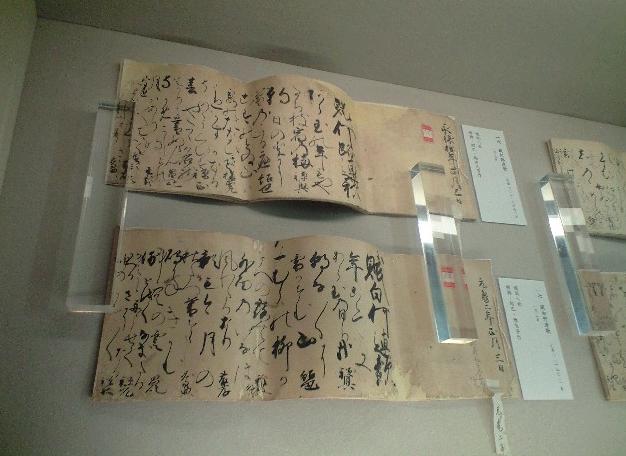
source : www.tulips.tsukuba.ac.jp
urajiro (urashiro) kaishi samples
上:賦何路連歌 永禄10(1567)年
下:賦白何連歌 元亀2(1571)年
quote
The Kitano Shrine is the Vatican of renga poets.
Renga isn't quite a religion, but in the medieval period many, many sequences were written to the god of the Kitano Tenjin Shrine, Sugawara Michizane (Tenjin), whose powerful soul was feared and venerated by the court for many centuries. It was the official shrine of the Ashikaga shoguns and patronized by them, and they often sponsored hooraku 法楽 or god-pleasing renga and hoonoo 奉納 or votive renga as well as all sorts of prayer renga and renga on the 25th of each month, since Michizane died on the 25th of the month.
They had a special room for renga meetings and a resident renga master, as did some of the bigger Tenjin-related Shinto shrines around the country. In Osaka the Tenjin shrine renga master when Basho and Saikaku were young happened to be Nishiyama Soin, who was also a pioneering renku poet who was able to give the young renku form prestige and protection due to his powerful position as master at a Tenjin Shrine.
The Kitano Shrine in Kyoto was at the apex of this network and represented orthodoxy itself. I mention this because the mentality of the leading renga poets in the late medieval period might have been highly focused on avoiding mistakes more than on creating great literature.
These Kitano renga masters were no doubt under great pressure from many powerful people, but their level of fastidiousness is amazing. The practice of using 8 sheets on the front side only instead of 4 sheets so that the scribe could correct any mistake on the back of the same sheet continued from 1557 to 1644.
Perhaps in the era of Tokugawa peace the Kitano Shrine was no longer were supported by great warlords, and the Tokugawas were away in Edo and more interested in Buddhism. And their big Shinto shrine was not Kitano but up north in Nikko. At any rate, the practice ended under the Tokugawas.
As far as the slang meaning of urajiro, a brief trawl didn't turn up anything. But ura, back, behind, of course is often used to talk about human anatomy, and Hideyoshi is famous for loving many of his pages (pun unintended). Machida is a modern haijin, so anything is possible, but I doubt that renga meetings at the august Kitano Shrine in the 16th and 17th centuries would have allowed for such humor.
Chris Drake
. Kitano Tenmangu in Kyoto 北野天満宮 .
. New Year Observance SAIJIKI .
:::::::::::::::::::::::::::::::::::::::::::::::::::::::::::::::::::::::::::::::::::::::::::::::::::
From the WKD library
Rensaku .. Gunsaku
From Renga to Haiku Sequences
Haikai and Renku
by Mark Jewel, Waseda University
:::::::::::::::::::::::::::::::::::::::::::::::::::::::::::::::::::::::::::::::::::::::::::::::::::::
Renga Terminology
quote
These words are presented as a shikimoku and variations of rule may exist.
hokku (発句):
The first stanza of renga with a 5-7-5 sound unit count. This stanza should be created by a special guest when present, and is considered a part of the greeting in a renga gathering. It must include a kigo (季語, "seasonal word"), as well as a kireji (切字, "cutting word" - a break in the text, usually, but not always, at the end of a line). The kigo usually references the season the renga was created in. Hokku, removed from the context of renga, eventually became the haiku poetry form.
waki (脇):
The second stanza of a renga with a 7-7 sound unit count. The one who helped to organize the gathering is honored with creating it.
daisan (第三):
The third stanza of a renga with a 5-7-5 mora count. It must end with the -te form of a verb to allow the next poet greater freedom in creating the stanza.
hiraku (平句): Refers to all verses other than the hokku, waki, daisan, and ageku.
ageku (挙句): The last stanza of a renga. Care should be taken to wrap up the renga.
kuage (句上げ): A note made after the ageku to indicate how many ku each poet read.
kōgyō (興行): To hold a renga gathering. May also be called chōgyō (張行).
wakiokori (脇起り, waki-okori : To start with the hokku of a famous poet such as Bashō and make a new waki verse to follow on from there.
tsukeai (付合): May also be called tsukekata (付け方) or tsukeaji (付け味). Refers to the mixing and matching of unlikely word combinations to spur imagination or evoke an image. One of the interesting features of renga.
maeku (前句: The verse in which tsukeai happens.
uchikoshi (打越): The verse before the maeku.
shikimoku (式目): A set of rules to lay out the stylistic requirements for change throughout the poem and to prevent a renga from falling apart.
renku (連句): Modern renga in the style of Matsuo Bashō.
kukazu (句数): Literally, "the number of verses".
When the theme of a section is a popular topic such as "Love", "Spring", or "Fall", the renga must continue on that theme for at least two verses but not more than five verses. This theme may then be dropped with one verse on any other topic.
sarikirai (去嫌): A rule to prevent loops repeating the same image or a similar verse.
rinne (輪廻): The name for a loop where the same theme, image, or word is repeated.
Term taken from Buddhism.
(The cycle of birth and rebirth; the world as commonly experienced.)
kannonbiraki (観音開き):
A type of loop where the uchikoshi and tsukeku have an identical image or theme.
haramiku (孕み句): A stanza prepared beforehand. Should be avoided as stanzas should be created on the spot.
asaru (求食る): To make two stanzas in a row. Happens frequently when the dashigachi rule is used. Should be avoided to let others join.
dashigachi (出勝ち): A rule to use the stanza of the first poet to create one.
hizaokuri (膝送り): A rule whereby each poet takes a turn to make a stanza.
renju (連衆): The members of a renga gathering.
ichiza (一座): Literally, "one seating".
Describes the group when the renju are seated and the renga has begun.
sōshō (宗匠, sooshoo): May also be called sabaki (捌き).
The coordinator of an ichiza, he or she is responsible for the completion of a renga. Has the authority to dismiss an improper verse. The most experienced of the renju should be the sōshō to keep the renga interesting.
kyaku (客): The main guest of the ichiza and responsible for creating the hokku.
teishu (亭主): The patron of a renga gathering, who provides the place.
shuhitsu (執筆): The "secretary" of the renga, as it were, who is responsible for writing down renga verses and for the proceedings of the renga.
bunnin (文音, bun-in): Using letters (i.e. the post), telegraph, telephone, or even fax machines for making a renga. Using the internet is also considered a form of bunnin.
((on)): Sounds, or syllables
© More in the WIKIPEDIA !
fushimono ふしもの【賦し物】 "set topics"
technique to place a name into a ku in two different places, later developed into the hokku.
sequences brought together through hidden words and images. Fushimono could also be riddles.
shikimoku しきもく【式目】 rules books
stating the rules to be observed when writing renga.
For example 応安新式 for renga.
:::::::::::::::::::::::::::::::::::::::::::::::::::::::::::::::::::::::::::::::::::::::::::::::::::
 kannonbiraki 観音開き (かんのんびらき)
lit. this is a door that opens to both sides of a cupboard, displaying the cupboard interior in the middle. This is in contrast to the sliding doors which are usual in a Japanese home.
The Buddha Shelf for the Ancestors (butsudan) in a home opens like this too, and usually shows the statue of a little Kannon Bosatsu, hence the name.
biraki ... hiraki 開き... hiraku ... to open
Flügeltür
:::::::::::::::::::::::::::::::::::::::::::::::::::::::::::::::::::::::::::::::::::::::::::::::::::
External LINKS
John Carley
http://www.renkureckoner.co.uk/
Ferris Gilli
http://www.simplyhaiku.com/SHv7n4/renku/GilliGrammar.html
Meter in Renku
http://www.haijinx.org/columns/notes-on-renku/do-metrics-matter/
Renku Group . Journal of Renga & Renku
http://renkugroup.proboards.com/
Tanaka Yuko (Hosei University in Tokyo)
http://littleonion.posterous.com/ren-the-mechanism-of-linking-in-japanese-cult
:::::::::::::::::::::::::::::::::::::::::::::::::::::::::::::::::::::::::::::::::::::::::::::::::::
Rengay
by J. Zimmerman
The Rengay is a North American variation on the Japanese linked verse form. It was invented in 1992 as a synthesis of:
Ren ("linked"), the syllable at the start of renga ("linked verse") and renku (originally "linked verse" in China; now a modern term for renga).
Gay, the last name of its inventor, poet Garry Gay. Also signifies the relatively light-hearted approach (as in senryu) that is often present in rengay.
History.
The original form of rengay, a 6-link collaborative poem by 2 poets, was invented in August 1992 by Garry Gay.
Gay was the first president (1989-1990) and co-founder of the Haiku Poets of Northern California and former president of the Haiku Society of American. He felt that many rules of the Japanese renku ("linked verse") were rather too complex and culturally irrelevant to North Americans.
To allow collaboration among three poets, the 6-link form was soon adapted to support the 3-person form of rengay.
The rengay differs from the renku
(and the historic renga) in:
and
Here are some steps to take in creating a Rengay:
READ the rest here
source : J. Zimmerman
waka renga
:::::::::::::::::::::::::::::::::::::::::::::::::::::::::::::::::::::::::::::::::::::::::::::::::::::
Yotsumono
hokku, wakiku, daisan and ageku
Mr J. E. Carley
Yotsumono is an exercise devised by the present author. It extends the historic Mitsumono exercise elsewhere on these pages by the addition of ageku as a closing verse.
The structure of the resultant four verse sequence is similar to that of the Chinese Jueju (Wade-Giles: Chue Chu), known in Japanese as the Zekku. It may be that the Yotsumono comes to be viewed as having some merit as a distinct form in its own right.
http://www.renkureckoner.co.uk/Yotsumono_exercise.htm
:::::::::::::::::::::::::::::::::::::::::::::::::::::::::::::::::::::::::::::::::::::::::::::::::::::
Waka 和歌 ・Tanka 短歌
Waka (和歌 literally "Japanese poem") or Yamato uta is a genre of classical Japanese verse and one of the major genres of Japanese literature. The term was coined during the Heian period, and was used to distinguish Japanese-language poetry from kanshi 漢詩 (poetry written in Chinese by Japanese poets), and later from renga.
The term waka originally encompassed a number of differing forms, principally tanka (短歌, "short poem") and chōka (長歌, "long poem"), but also including bussokusekika, sedōka (旋頭歌, "whirling head poem") and katauta (片歌, "poem fragment").
These last three forms, however, fell into disuse at the beginning of the Heian period, and chōka vanished soon afterwards.
Thus, the term waka came in time to refer only to tanka.
© More in the WIKIPEDIA !
quote
James Kirkup:
A final word of advice:
when making tanka, do not forget that poetry must obey its own laws of logic. That is, the "argument" or "plot" of a tanka must proceed logically and in a natural manner, taking care to preserve the sequence of the tenses, and not change from present to past in the same poem. Poetry demands strong control, and airy, dreamy nothings, however picturesque, are absurd when ungrammatically presented. Even the most romantic and emotional poems depend for their existence upon a cool, logical mind in the poet.
For this reason, some of the tanka, though touching, were an emotional mess, and embarrassing to read. In future, poets, keep a cool head and a firm grip upon syntax when you compose even the most passionate of love poems!
source : littleonion.posterous.com, August 2010
quote
Nomori no kagami and the Perils of Poetic Heresy
By R. Keller Kimbrough
Introduction
Poetic composition was extremely serious business in Kamakura-period Japan (1185-1333). The era boasts the Shinkokin wakashû 新古今和歌集, possibly the greatest of all Japanese poetic anthologies, as well as many sophisticated and highly theoretical works of poetry criticism, most of which have yet to be translated or adequately researched in or outside of Japan. The following article, written for an academic conference at Purdue University in October 2002 and previously published in the 2003 conference proceedings,1 concerns one such late thirteenth-century poetic treatise: Nomori no kagami 野守鏡, an angry polemic directed at the new poetic style of Kyôgoku Tamekane 京極為兼 (1254-1332), a great-grandson of the eminent Fujiwara no Teika 藤原定家 (1162-1241) and a poet who would achieve fame in his own and later generations for the stylistic innovations of his verse. As one of many contentious Kamakura-period commentaries, Nomori no kagami offers us insights today into the rich, unsettled, and sometimes menacing world of early-medieval poetics.
Nomori no kagami and the Perils of Poetic Heresy
In the ninth month of the third year of Einin 永仁 (1295), an anonymous critic composed a Buddhist poetic commentary by the name of
Nomori no kagami, “Mirror of the Watchman of the Fields.”
The work is both a vitriolic attack upon the new poetic style of Kyôgoku Tamekane, who had recently been chosen to edit the imperial anthology Gyokuyô wakashû 玉葉和歌集, and an angry denunciation of the fledgling Pure Land and Zen sects of Kamakura Buddhism. In the twentieth century, scholars have been largely concerned with establishing the identity of the author and the circumstances of the work’s composition. Fukuda Hideichi has argued that it was written by a Tendai priest affiliated with both the Enryakuji Eastern Tower at Sakuramoto (Mount Hiei), and the Gyôzan 魚山 school of shômyô 声明 sutra chanting.3 Ogawa Toyo’o has more recently suggested that the author was a priest by the name of Kujin 公尋, a disciple of Kôkaku 光覚 in the Gyôzan shômyô lineage.4 Other than such biographical or essentially religious inquiries, Nomori no kagami has received little attention in the modern period. Nevertheless, from the perspectives of Buddhist literary studies and early-medieval poetics, it is an important work because of its unique and radical extensions of prevailing theories of Buddhism and waka 和歌 (Japanese poetry).
MORE
source : simplyhaiku.com 2007
:::::::::::::::::::::::::::::::::::::::::::::::::::::::::::::::::::::::::::::::::::::::::::::::::::::
hachidaishuu soosakuin 八代集総索引 Halchidaishu Sosakuin
Index of Shin Koten Nihon Bungaku Taikei.
- reference -
:::::::::::::::::::::::::::::::::::::::::::::::::::::::::::::::::::::::::::::::::::::::::::::::::::::
. Shrine Sakaori no Miya 酒折宮
and Yamato Takeru 日本武尊, first Deity of Renku
. Matsuo Basho 松尾芭蕉 - Archives of the WKD .
. . . . . BACK TO
My Haiku Theory Archives
:::::::::::::::::::::::::::::::::::::::::::::::::::::::::::::::::::::::::::::::::::::::::::::::::::::
[ . BACK to DARUMA MUSEUM TOP . ]
[ . BACK to WORLDKIGO . TOP . ]
- #waka #wakapoetry #wakajapan -
:::::::::::::::::::::::::::::::::::::::::::::::::::::::::::::::::::::::::::::::::::::::::::::::::::::
7/30/2007
Renku, Linked Verse, waka

7/24/2007
Unison (shoowa) . honkadori
[ . BACK to WORLDKIGO TOP . ]
:::::::::::::::::::::::::::::::::::::::::::::::::::::::::::::::::::::::::::::::::::::::::::::::::::
Unison (shoowa 唱和)
Other than a renku, which uses different words, a "unison" haiku uses mostly the same words of the original; the poet changes just a few to show his appreciation of the original. This technique is used when two haiku poets are very close and respect each other.
It can also be used when writing a thank you note or greeting note to a haiku friend, using one of his haiku and make a "twin poem".

Photo © Gabi Greve, 2001
:::::::::::::::::::::::::::::::::::::::::::::::::::::::::::::::::::::::::::::::::::::::::::::::::::
Santoka and Hosai
mo hitori も一人
Santoka in unison with Hosai Koji's haiku:
鴉啼いてわたしも一人
The cawing of a crow -
I also am alone.
Santoka
* Osaki Hosai 尾崎放哉 was a haiku poet who belonged to the same school of free haiku originated by Seisensui Ogiwara. Santoka and he knew of each other but never met.
Hosai wrote many poems of his loneliness and the below poem is in unison with this famous haiku:
咳をしても一人
Even coughing -
I am alone.
Ozaki
© terebess.hu

. Santoka and Ozaki .
:::::::::::::::::::::::::::::::::::::::::::::::::::::::::::::::::::::::::::::::::::::::::::::::::::::
© 大岡 信 Ooka Makoto
唱和のダイナミズム
いうまでもなく、俳諧文学は、いわば和歌文学の胎内から必然の勢いで誕生した文芸形式である。その歴史を過去にまでさかのぼろうとすれば、日本の歴史始まって以来のあらゆる文学形式にも縁戚関係を求めうるような、豊饒な図柄が出来上がるであろう。
俳諧文学の本質的な性格は、相手の声に応じて心と言葉を合わせ、こたえるという点にあった。
唱和するということは、この短小な文学形式の本質をなしており、この形式が世界最短の文学形式といわれながら、きわめて長期にわたって生き生きと活動しつづけてきた理由も、この唱和のダイナミズムを保ちつづけているという貴重な性格にあることはいうまでもないだろう。この俳句大事典に戻っていえば、今言った唱和のダイナミズムは、事典を引く側にも当然生じうることである。
:::::::::::::::::::::::::::::::::::::::::::::::::::::::::::::::::::::::::::::::::::::::::::::::::::::
ruiku 類句 similar poem, similar haiku
Reference
:::::::::::::::::::::::::::::::::::::::::::::::::::::::::::::::::::::::::::::::::::::::::::::::::::::
ume ichi-rin ichirin hodo no atatakasa
Hattori Ransetsu (1654-1707)
ume ichirin ichirin dake ja haru samushi
one plum blossom
just one plum blossom -
spring is still cold
Gabi Greve
Read the discussion HERE !
:::::::::::::::::::::::::::::::::::::::::::::::::::::::::::::::::::::::::::::::::::::::::::::::::::
With allusion and with honkadori,
if the reader does not know the original you are referring to, he will think all the lines of a haiku are original from the poet.
So if you write a haiku with an allusion, better give a footnote with the quote you are referring to.
I tend to call this "Haiku in Context".
Japanese haiku poets were lucky to write in a rather closed society during the Edo period, educated poeple knew what they knew and could compose haiku with allusions to the Chinse classics and old waka without a problem. A translation for a European or American audience is usually not enough, it needs more information of the Japanese background.
Therefore when translating from Japanese, I can not expect the European reader to know all the cultural implications, so I give more background information and present the translation as a "Haiku in Context".
Haiku should be a "stand alone",
but only if the proper context is know to all readers.
This is hard to accomplish in a worldwide online haiku scene.
Therefore I propagate
Haiku in Context
also for haiku magazines and publications.
Writing honkadori is not the work of a copycat (copy cat), but a work showing respect to the masters.
But if you are not sure, best give a link or note to the haiku you are referring to, when you attempt to write one.
Even using a kigo is kind of a honkadori,
since you are now in company with all the haiku poets who used this kigo before.
Gabi Greve
:::::::::::::::::::::::::::::::::::::::::::::::::::::::::::::::::::::::::::::::::::::::::::::::::::
quote
I can well understand if someone finds in a magazine or website a haiku which resembles strongly to the one he/she has had published before and feels that his/her work has now been stolen or somehow violated, with a possibility that it may well have been plagiarised. Many would feel the same even if the resemblances were slight. The sentiment must in essence be the same as when one comes home only to find that the house has been burgled.
This is a natural reaction. However, is it that simple?
First and foremost, why should one be so negative about it? Positively, “imitation is the sincerest form of flattery” If one’s haiku is copied to a larger or lesser extent, it can mean that someone else has thought it is worth copying. If the act is sincere, it is a form of praise. It can also mean that others wish to learn from it, in which case one is inadvertently spreading good influence among the fellow haiku poets. Man is an imitating animal. We imitate right from the time we are born. We do it more or less all the time. How would we acquire a language, except by imitation? Indeed, 99 per cent of what we are, what we know, what we say and what we write may be not ours! And that is not a bad thing at all. Without it, our society, nation or even the whole world would collapse. So, to be genuinely original is not an easy thing to achieve in real terms, if not impossible, and significantly it has always been feared or rejected as something dangerous. This is an important point for a haiku poet to bear in mind before he/she goes out and shouts that his/her haiku has been copied.
Secondly, if one’s haiku is created independently and in isolation to the one similar to it, there is in reality and virtually nothing the other author can do about it. If both of them are good, that is something we haiku poets (and non-haiku poets) should celebrate for them and for ourselves. If one of them is bad, that should show up in everybody’s eyes and the matter should end there. If both of them are bad, they should be discarded quietly and no dispute should arise.
Thirdly, learning has always been imitating (emulating is the correct word) in Japan and haiku is a Japanese product. This is still largely true, though there are exceptional individuals who go their own ways (mainly as a result of Western influence). Students learn in the way they will become more and more like their teachers and hopefully as good as them.
... However, these educational institutions cannot adequately provide all the students with all their needs because there are so many gaps one wants to learn. Special subjects such as haiku are especially the case in point. Courses in haiku and those qualified to teach haiku in them are really few and far between in the world, outside Japan. All this means that haiku is an untested, un-taught, uncharted and unexplored territory which can become either a new and exciting fertile ground for literary creation or a wasteland leading to such undesirable concomitants as “anything goes”, the whole world becoming haiku wild west, mushrooming of self-appointed teachers, the blind leading the blind, deteriorating quality, misconceptions becoming rules, poems of little value mass produced in haiku factories and put on shelves of haiku super markets, inferior works becoming worshiped and emulated, one dominating trend pervading every corner of the world etc. etc.
... Follow tradition first, and only then, start seeking originality, and if you are not quite sure at times about the quality of the originality always do not fail to come back to the tradition. In other words, tradition should be the starting point and should remain the reference point. If you are learning about pine trees from pine trees and about bamboos from bamboos, or follow what people in the past sought and not the people themselves (idolatry), you should learn about haiku from the Japanese haiku tradition and follow what the Japanese haiku poets of the past sought.
Susumu Takiguchi
source : WHR December 2011
.................................................................................
THE MEANINGLESSNESS OF WRITING
SANTOKA-LIKE HAIKU AFTER HIM
by Susumu Takiguchi
The literal meaning of haiku poems written by Santoka Taneda (1882-1940) is not that difficult to convey in translation into different languages. This is mainly because his words are clear, specific and plain. However, the style, choice of words and the rhythm of his haiku so distinct in the original Japanese get largely lost in translation. They are so distinct that ironically it is not difficult at all to create Santoka-like haiku in Japanese.
As far as I know, there has been little attempt by any Japanese haiku writers to compose haiku in the style of Santoka or even by imitating his works. In his days there were obviously poets of the vers libre school such as the group called Soun, who wrote haiku poems similar in style to Santoka, and of course there was Hosai Ozaki (1885-1926). This is somewhat puzzling when compared with poets like Kyoshi Takahama (1874-1959) in whose style millions of Japanese haiku poets have written their works.
There are millions of copycats for Kyoshi and none for Santoka.
source : terebess.hu
:::::::::::::::::::::::::::::::::::::::::::::::::::::::::::::::::::::::::::::::::::::::::::::::::::::

The Honkadori Project
'honka-dori, honkadori ほんかどり【本歌取り】
Strictly speaking, this is a technical term for waka and renga, and later was also adoped for haikai-no-renga with specific rules about its use. It therefore is not really a term to be used for haiku but nevertheless people do. Honka in honka-dori, also called moto-uta, means an original poem (if it is an original text or episode, it is called hon-setsu).
Honka-dori is an action to write a new poem but alluding to a honka.
When writing a honkadori about a poem which is not so well known, the author should introduce the original, state his reasons for writing his own version and then write it down too. Thus the reader will know it is not a "stand alone", but a "haiku in context".
. striking a temple bell
Soseki and Shiki
. blue sharks, whales, seals and blossoms
Kaneko Tohta and the Danrin schooll
. The old Buddha Statues of Nara
Basho and Masaoka Shiki
.................................................................................
世にふるも更に時雨のやどり哉
yo ni furu mo sara ni shigure no yadori kana
life in this world
just like a temporary shelter
from a winter shower
Soogi 宗祇(そうぎ) Iio Sogi (1421 - 1502)
Tr. Ueda Makoto
世にふるも更に宗祇のやどり哉
yo ni furu mo sara ni Soogi no yadori kana
life in this world
just like a temporary shelter
of Sogi's
Matsuo Basho
Tr. Ueda Makoto
WKD . winter drizzle (shigure) .
.................................................................................
寝ぐるしき伏せやを出れば夏の月
negurushiki fuseya o dereba natsu no tsuki
hard to find sleep
I get up and outside
the summer moon
Yosa Buson
川口や湯舟を出れば夏の月
Kawaguchi ya yubune o dereba natsu no tsuki
Kawaguchi -
I get out of the bathtub and outside
the summer moon
Masaoka Shiki
:::::::::::::::::::::::::::::::::::::::::::::::::::::::::::::::::::::::::::::::::::::::::::::::::::
Plagiatism
"There is nothing new in the world
except the history you do not know."
--Harry S. Truman
An Introduction to Déjà-ku
by Michael Dylan Welch
Déjà-ku: The Problem of Haiku Uniqueness
There's the rub. Writing similar poems should never be a problem. Let yourself be free to write. Editing and selection comes later. Only when one wishes to publish might one have to think about whether a poem is fresh or distinct enough. If a poem is too similar to something already published, then perhaps the newer poem should not be published, for only one person can be "first to the patent office." Editors will also help with this matter, as best they can. This step requires a certain degree of "haiku literacy"--knowing the literature well enough to know whether certain subjects have been written about, and in what ways.
This is complicated by problems of translation and various wordings for the same poem. No one can be expected to keep up with all haiku in Japanese and English, including all the translations going back and forth. Thus I think we should all be understanding when a poem may get too close to another. There are limits, but unless it's willful plagiarism, I think we should be tolerant and understanding of each other and the similarity of some of our poems.
In the cases of the "good" kind of déjà-ku-- parody, homage, and allusion-- there is little for the writer to worry about beyond what one should be concerned about in any sort of haiku: Will the reader understand it, get the connection to the other poem, and feel the same feelings that the poet felt in having a given experience? None of these sorts of poems can reach their full potential, of course, unless the reader knows the poem that is being referred to.
Read the full essay here
© Michael Dylan Welch, Simply Haiku
................... One of my own examples

late autumn sun -
the shadows of leaves
on leaves
What a Coincidence !
autumn deepens
the shadow of a leaf
on a leaf
soji
Mine was written in response to Ray Rasmussen's photo on Mitsuge Abe's Photo Haiku Gallery, you can see it here: Photo Haiku Gallery
What is it they say, "Great minds run in the same track..."?
soji
:::::::::::::::::::::::::::::::::::::::::::::::::::::::::::::::::::::::::::::::::::::::::::::::::::::
plagierized haiku <>
does it really come
from MY heart ?
plagierized haiku <>
how much does style
matter ?
first minus morning -
is winter plagiarizing
itself ???
minus centigrade, that is here in Japan. All is white with frost.
And it is the same feel as the first minus morning last year ... COLD !
Gabi Greve
:::::::::::::::::::::::::::::::::::::::::::::::::::::::::::::::::::::::::::::::::::::::::::::::::::
Waking from Zhuangzi’s Butterfly Dream?
-- Plagiarism or Honkadori
by Chen-ou Liu
Veteran haiku poet and editor Cor van den Heuvel gives an incisive explanation about these perspective differences:
“If a haiku is a good one, it doesn’t matter if the subject has been used before. The writing of variations on certain subjects in haiku, sometimes using the same or similar phrases (or even changing a few words of a previous haiku), is one of the most interesting challenges the genre offers a poet and can result in refreshingly different ways of ‘seeing anew’ for the reader.
This is an aspect of traditional Japanese haiku which is hard for many Westerners, with their ideas of uniqueness and Romantic individualism, to accept.
But some of the most original voices in haiku do not hesitate to dare seeming derivative if they see a way of reworking an ‘old’ image.”
source : Simply Haiku, Autumn 2010, Vol. 8. No. 2
Modes of Quoting: Parody and Honkadori
Akiko Tsukamoto
Through a large part of its known history Japanese culture showed certain characteristics that made it relatively easy for it to serve as container for foreign cultural content by providing clever and skillfully selective devices for the borrowing and importing of elements of various cultures and keeping and re-shaping them in its own way. It is also true that the Japanese have traditionally not cared as much as Westerners about the originality and novelty of their ideas or styles.
The 'art of quoting', Honkadori, appeared later, in the Kamakura period (11th to 13th century).
Honkadori emerged in the Kamakura period, when there were few anonymous poems, and most authors tried to display their originality whilst at the same time demonstrating the historical continuity of Japan.
In traditional rhetorical theory one comes across the term 'allusion', which is a kind of quoting in a wide sense, but in a narrower sense it breaks a fundamental rule of quoting: an allusion contains no explicit reference.
Parody has been called a parasitic and derivative art and has on occasion been seen as the philistine enemy of creative genius and vital originality.
The Japanese did not fully recognise the value of originality or respect formal copyright; and the spiritual value of a work of art, which was the essential point of it, was considered not to come from the artist but rather from the artist’s spiritual state which allowed him to directly access an absolute Truth or Way. The True Way is found and lost, and one cannot 'own' it, a way of thinking central to Buddhist philosophy. The effect was to reduce, if not exactly eliminate, the perception that the artist was an original creator.
However, whether a Honkadori is successful or not depends on the particular effect which appears or does not appear at the stage of appreciation. Teika’s aesthetics always assumes an objective reader possessing full knowledge and the ability to grasp well-made allusions and references.
Of course, if an actual reader does not know the original poem he may fail to grasp and appreciate it, but Japanese court poetry was intended for a class of connoisseurs, which of course is the only context in which this sort of use of quotation can play the desired role.
The practice of Honkadori will be summed up in several key points:
o
the quotation of an old poem is used to make one’s present situation emotionally more explicit. In this case the present situation becomes an example, or representation, or repetition of the old poem. The present vague 'my situation' acquires a definite contour and objectivity, thanks to the type or model. Thus it is no longer 'private' and can be understood by others.
o
by using the old poem as a 'raw material' and the operation of quoting, one can re-shape the old poem and make the intention and technique of re-shaping itself the object of appreciation.
o
In both cases the situation in which the quoted poem was created is of central importance. In the first case to absorb the present situation into the model, and in the second case quotation is enjoyed only in the present context.
Read the full article HERE
Simply Haiku, Vol. 2, 2004
.................................................................................
aki fukaki tonari wa nani o suru hito zo
Basho
. autumn deepens (aki fukaki) the KIGO
aki fukaki haijin wa nani o kaku hito zo
autumn deepens -
I wonder what my haiku friends
are writing right now
Gabi Greve, November 2010
:::::::::::::::::::::::::::::::::::::::::::::::::::::::::::::::::::::::::::::::::::::::::::::::::::::
Parody - 滑稽 kokkei
Poets also like to parody a famous haiku, just remember the 100 FROG haiku.
100 Frogs ... One Hundred Frogs
If the haiku is not so famous, it is better to state the one of origin too.
The same holds for haiku that you write "being inspired by a haiku of Mr./Mrs. xyz".
There is nothing wrong with doing this, as long as you state (best with HTML) where you got your inspriation from.
::::::::::::::::::::::::::::::::::::::::::::::::::::::::::::::::::::::::::::::::::::::::::::::::::
An allusion is a reference to, or representation of, a place, event, literary work, myth, or work of art, either directly or by implication.
. Allusion used in Haiku
*****************************
Reference
. . . . . BACK TO
My Haiku Theory Archives
::::::::::::::::::::::::::::::::::::::::::::::::::::::::::::::::::::::::::::::::::::::::::::::::::
7/14/2007
Nape of the neck
[ . BACK to WORLDKIGO TOP . ]
:::::::::::::::::::::::::::::::::::::::::::::::::::::::::::::::::::::::::::::::::::::::::::::::::::
Base of the nape (bon no kubo)
***** Location: Japan
***** Season: Non-seasonal Topic
***** Category: Humanity
*****************************
Explanation
nape of the neck, bon no kubo 盆の窪 (ぼんのくぼ)
..... bon no kubi ぼんの首
"nape" means "back of the neck".
... ... ...
Some Japanese theories about this expression
bon 盆 written with kanji for "tray" is maybe short for boozu 坊主, a bald priest head, where the nape can be seen very clearly.
The hairstyle of children in the Edo time with a little tuft seems not be be related to this BON. This BON ぼん is written with hiragana.
Another theory says BON is a sloppy pronounciation of HONE ほね, bones. 骨窪
Here is more in Japanese.
gogen-allguide.com
:::::::::::::::::::::::::::::::::::::::::::::::::::::::::::::::::::::::::::::::::::::::::::::::::::::
the hair stand up on the back of our necks!
Larry
It is quit untreatable.
We Japanese could sympathize with your phrase.
[Bon no kubo] is basically fear. And when we feel fear all hairs on our head stand vertically up. In this state we say "zotto suru ぞっとする".
I think if person understand this state of mind, any reference of this part of the body is all suitable to be used.
Nakamura Sakuo
zotto suru ぞっとする :
恐怖や寒さなどで、身体(からだ)が震え上がるような感じがする。全身の毛が逆立つように感じる。
例:「ぞっとするほどの美人」
© tomomi965
:::::::::::::::::::::::::::::::::::::::::::::::::::::::::::::::::::::::::::::::::::::::::::::::::::::
Nape at the hollow of the neck:
A baby's head was shaved, but if a small tuft of hair was left growing at the nape it too was known as bon no kubo.


Prints by Kunisada
Here are two details from prints by Kunisada.
Notice the subtle indications of the areas at the back of the the head at the nape where the hair has been allowed to grow.
© JAPANESE PRINTS / Jerry Vegder 070715
xxxxxxxxxxxxxxxxxxxxxxxxxxxxx
*****************************
Worldwide use
*****************************
Things found on the way
*****************************
HAIKU
ずんずんとぼんの凹から寒さかな
zunzun to bon no kubo kara samusa kana
Issa
from the nape of my neck
chilling, chilling, chilling ...
the cold
First tentative version by Gabi
More translations by Michael Haldane
Translating Haiku Forum
:::::::::::::::::::::::::::::::::::::::::::::::::::::::::::::::::::::::::::::::::::::::::::::::::::::
More haiku by Issa
bon no kubo yûhi ni mukete hibachi kana
on the nape
of my neck, setting sun
and hibachi
.....
temakura ya bon no kubo yori tobu hotaru
hands for a pillow--
from the nape of my neck
a firefly flits
.....
tsuribito no bon no kubo yori kaeru kari
behind the fisherman's neck
departing
geese
.....
yami no yo no hatsu yuki rashi ya bon no kubo
dark night--
the first snowflakes
hit my neck
.....
hana tsumu ya ôgi wo choi to bon no kubo
picking flowers--
his paper fan stowed
behind his neck
.....
bonokubo ni ôgi o choi to ko bôzu
he stows his fan
behind his neck...
little boy
.....
no-botoke no bon no kubo yori ume no hana
from the nape
of the field Buddha's neck...
plum blossoms
.....
kawahori ya yotaka ga bon no kubomi yori
bats--
and behind my neck
a nighthawk
.....
bon no kubo kara hiyashi keri ama no kawa
on the nape of my neck
a chill...
Heaven's River 
© Haiga by Nakamura Sakuo
Tr. David Lanoue
*****************************
Related words
***** More Haiku by Issa and Japanese Culture
::::::::::::::::::::::::::::::::::::::::::::::::::::::::::::::::::::::::::::::::::::::::::::::::::


 Posts
Posts


